

Deep Sea: Another Universe in Our Planet
Think about this for a moment: We spend billions of dollars sending telescopes, satellites, and spacecraft toward the sky above our heads. We analyze the soil of Mars, we dream of the glacial oceans on Jupiter's moons, we search for interstellar signals.
Yet right here beneath our feet, on the very surface of this planet, lies an unexplored universe. The deep sea, dark, cold, under crushing pressure, and almost entirely unknown. The ocean floor is Earth's last great frontier, and we've barely touched it.
The Unknown Face of the Planet We Stand On
Approximately seventy percent of Earth's surface is covered by oceans. Yet more than eighty percent of this vast body of water has never been mapped, observed, or even touched. To put that in perspective: we know the surface of Mars better than we know the floors of our own oceans.
The resolution of the Moon's topography is far greater than that of our seafloor maps. This is one of the strangest ironies in human history. While we fix our eyes on the sky to peer into the depths of the universe, we hesitate to step into the largest room of our own home.
Perhaps we are afraid of the dark. Because the deep sea is, quite literally, dark. Sunlight cannot penetrate more than about two hundred meters below the water's surface. After that? An endless, ink-black darkness. And within that darkness, life teems. For more context on how little we know, NOAA's ocean exploration overview lays it out starkly.
Creatures That Produce Light in the Dark
One of the most fascinating features of the deep sea is bioluminescence, the ability of living creatures to produce their own light. For those of us who live on the surface, this seems almost like magic. But down below, in the depths where sunlight never reaches, it is a survival strategy.
To lure prey, to startle predators, to find a mate, light in the darkness is life itself. Think of an anglerfish: a bioluminescent lure dangling from the top of its head, swaying like a tiny lantern in the endless dark. Every small fish drawn to that light is swimming straight into a trap.
Savage? Perhaps. But it is also one of evolution's most elegant solutions, refined over millions of years.
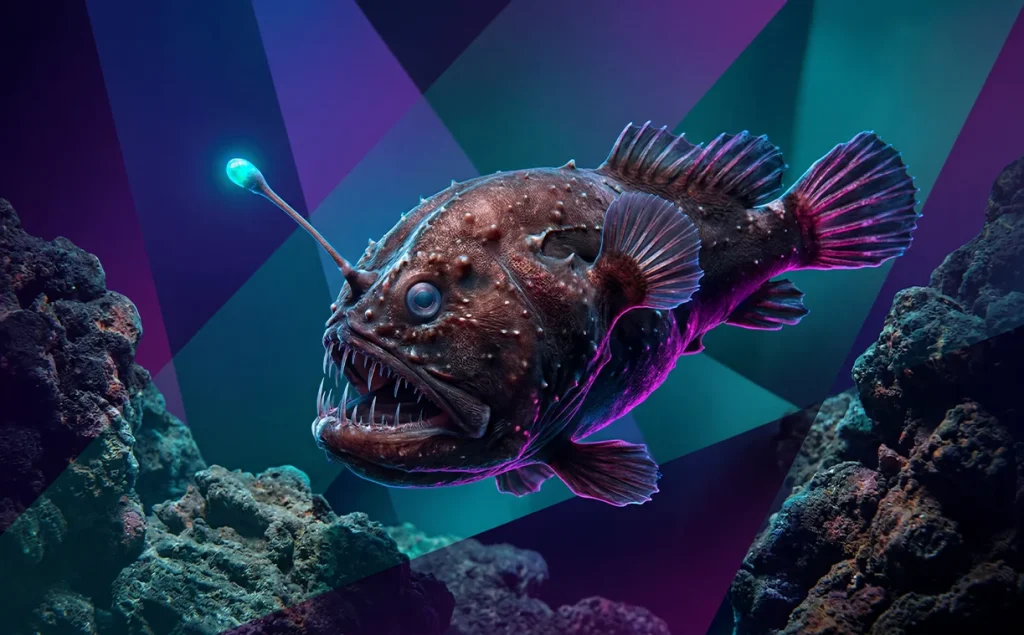
And it is not just the anglerfish. Deep-sea jellyfish species, certain types of squid, and even single-celled organisms produce light. Estimates suggest that more than seventy-five percent of the creatures living in the deep sea make use of bioluminescence in some way.
Consider this: down there, in a place the sun has never touched, living things have created their own stars. We often say we are made of stardust, deep-sea creatures have taken that one step further. Beings made of stardust, igniting their own light in a place without stars.
Deep Sea Hydrothermal Vents: The Place Where Life Began?
In 1977, near the Galápagos Islands, scientists discovered something on the ocean floor that shook our understanding of biology to its core. Hydrothermal vents, columns of superheated, mineral-rich water gushing from cracks in the seafloor. And surrounding these vents, communities of living organisms that had built their own ecosystems, entirely independent of sunlight.
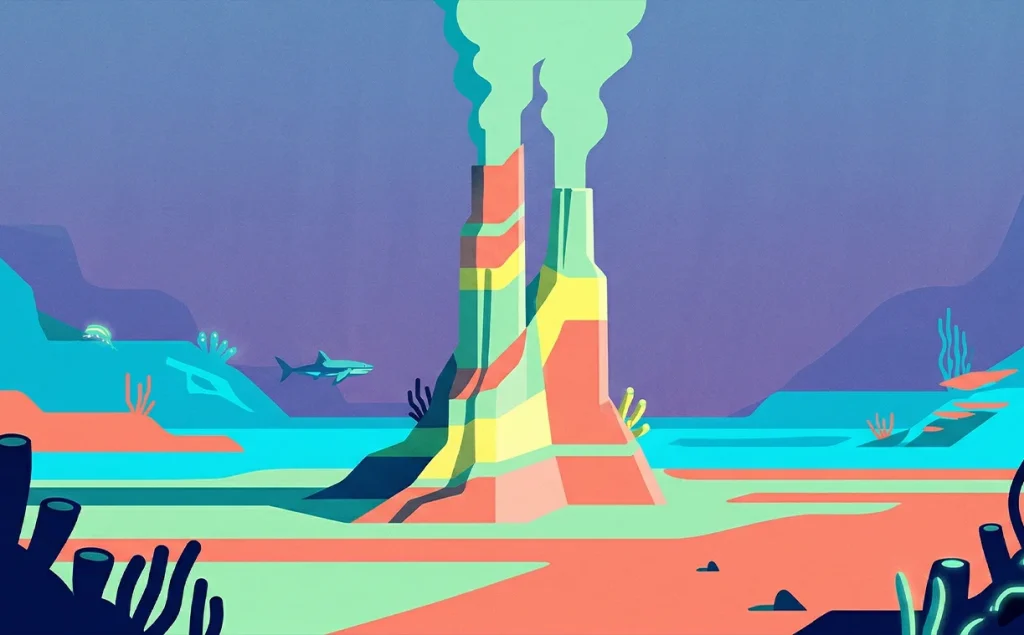
Why was this discovery so staggering? Because up until that point, we placed the sun at the foundation of all life. Photosynthesis, the beginning of the food chain, the source of energy, everything was tied to the sun. Until we found these vents.
The bacteria surrounding hydrothermal vents carry out chemosynthesis. Instead of solar energy, they use chemical energy to produce organic matter. They use compounds such as hydrogen sulfide and methane as energy sources.
Built upon these bacteria is an entire ecosystem: giant tube worms, blind shrimp, strange crustaceans, all sustained in a sunless world by the internal heat of the planet.
Now carry that knowledge somewhere else: Jupiter's moon Europa, or Saturn's moon Enceladus. Both likely harbor liquid water oceans beneath their icy crusts. Sunlight cannot reach those places, but if hydrothermal vents exist there, if chemosynthesis is possible, then life may be far more widespread than we ever imagined.
The discoveries at the bottom of our own oceans are, in fact, drawing the map for our search for life in space. What a beautiful cycle, isn't it? If you're curious about life beyond Earth, check out our science articles for more on astrobiology and space exploration.
A New Species With Every Deep Sea Dive
One of the most exciting aspects of deep sea research is this: new species are introduced to science on nearly every serious exploratory dive. Every single time. This is something that would be almost impossible on land.
Even in the Amazon rainforest, new species discoveries are limited to a few dozen per year. But at the bottom of the ocean, it seems as though a new creature emerges from under every rock. The reason is simple yet astonishing: we simply do not go there often enough.
The number of crewed deep-sea vehicles can be counted on one hand. Remotely operated vehicles are more common, but even they are little more than a single drop compared to the vast scale of the ocean.
With the 2020s came a significant acceleration in deep sea exploration technologies. Stronger materials, better cameras, vehicles capable of remaining at depth for longer periods.
In recent dives to the deepest points of the Pacific, soft coral species never before recorded, transparent jellyfish, and organisms engaged in strange symbiotic relationships have been observed.
And every new species is not merely a catalog entry. Each one carries a new clue about evolutionary biology, a new possibility in biochemistry, and even a new hope for medicine.
Compounds derived from deep-sea organisms are being investigated as drug candidates against antibiotic-resistant bacteria. Enzymes that function under extreme pressure could revolutionize industrial processes.
Hidden within the darkness may be the answers that will illuminate humanity's future. Learn more about cutting-edge discoveries in our science and nature coverage.
Deep-Sea Mining: Consuming Before We Discover?
But every beautiful story has its shadow. The deep sea attracts not only scientists but also mining companies. On the ocean floor, particularly in the form of polymetallic nodules, potato-sized mineral lumps containing valuable metals such as manganese, nickel, cobalt, and copper, there are enormous quantities of resources.
These metals are critical for battery technology and the electronics industry. The International Seabed Authority is working on regulations for deep-sea mining, and the issue has become one of the most contentious environmental debates of the 2020s.
On one side, the minerals needed for the green energy transition; on the other, the irreversible destruction of ecosystems we have barely begun to understand. It is worth pausing to reflect on this.
This is a form of mining that risks destroying creatures we have not yet even named — it is like burning a library before we have even learned to read the language of the books inside.
Cosmic Humility, at the Bottom of the Deep Sea
Carl Sagan once looked at a photograph of Earth taken from space and called it the "pale blue dot." Within that dot lie all our wars, our loves, our discoveries, our fears. Yet the largest part of that pale blue dot, the very thing that gives it its blue color, the oceans, remains a mystery to us.
We search for water around planets orbiting distant stars. We scan the far side of the galaxy for traces of life. And these are wonderful, necessary, inspiring pursuits. But at the same time, we need to hold a lantern up to the deepest rooms of our own home.
The deep sea offers us a cosmic lesson: The undiscovered is not always far away. Sometimes it lies beneath your feet. Sometimes it is within the darkness. And sometimes, in that darkness, creatures that create their own light are waiting for you. For millions of years, patiently, silently.
If the universe created us in order to know itself, and that is a beautiful thought — then perhaps a tube worm in the deepest, darkest corner of this planet is also part of the universe's effort to understand itself. A millions-of-years-old experiment in existence, living by the light of chemistry in a sunless world.
We are stardust, yes. But we are also ocean dust. And the bottom of that ocean calls to us as one of science's last great frontiers. The real adventure is much closer than we think, just a few kilometers below, in the darkness of the water, waiting to be discovered.