
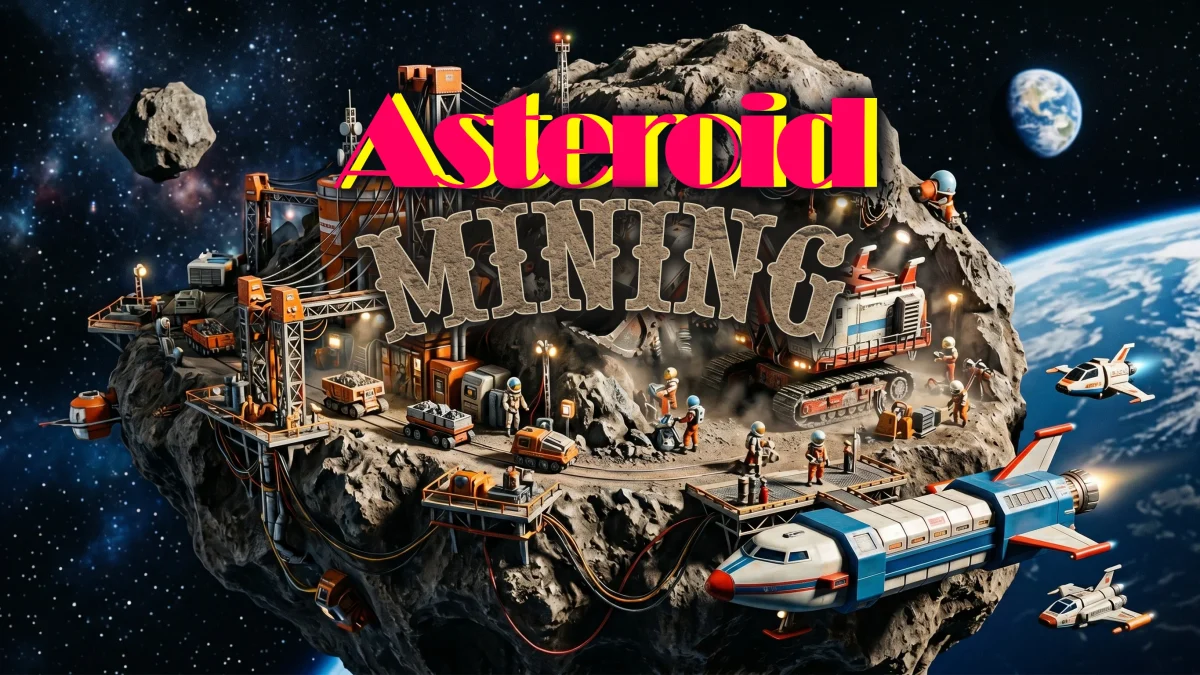

Asteroid Mining: The Gold Rush in Space Has Begun
When gold was discovered in California in 1848, thousands of people dropped everything and rushed westward. That same feeling exists now. But this time, the direction is not west. It is up. Asteroid mining is no longer a dusty page from a science fiction novel. It is the everyday conversation of billion-dollar investment plans, space agencies, and entrepreneurs.
Think about this for a moment: the estimated total mineral wealth contained in the asteroids near Earth is measured in quadrillions of dollars. Yes, I said "quadrillions." That is thousands of times the total GDP of Earth.
How Rich Is an Asteroid?
Asteroids are not just piles of rock. Their contents vary incredibly depending on their type. Think of it like a restaurant menu, except everything on that menu is valuable enough to turn the global economy upside down.
- C-type (carbonaceous) asteroids: They contain water and organic compounds. They could serve as sources of fuel and drinking water for space stations.
- S-type (silicate) asteroids: They contain nickel, iron, and magnesium. They can be thought of as construction materials.
- M-type (metallic) asteroids: This is where the real jackpot lies. Platinum group metals, gold, nickel, and cobalt. The amount of platinum contained in a single medium-sized M-type asteroid could overshadow all of Earth's historical platinum production.
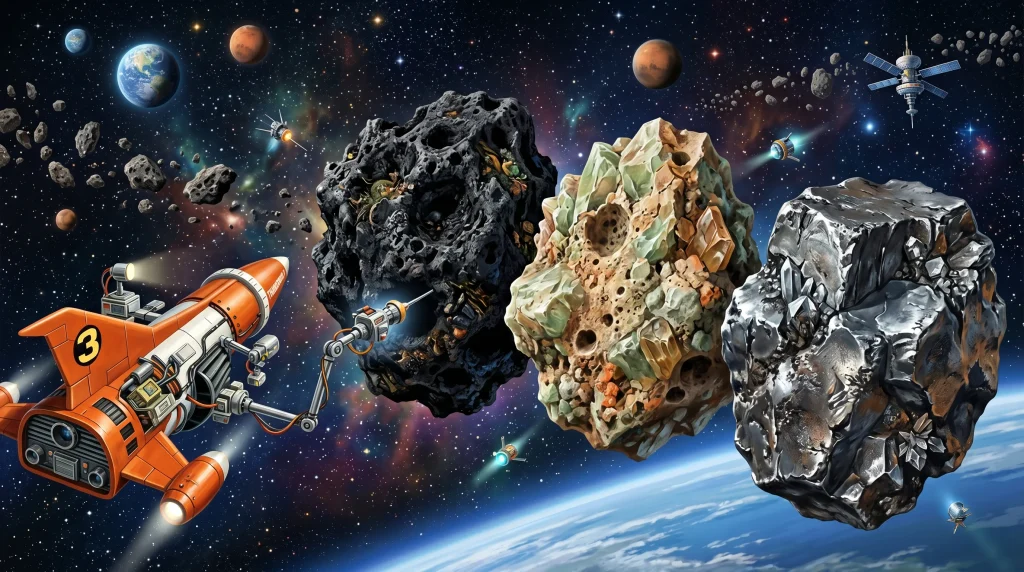
The asteroid known as 16 Psyche, or simply Psyche, is one of the most striking examples in this regard. This metallic giant, composed primarily of iron and nickel, is estimated by astronomers to contain staggering amounts of precious metals.
NASA's Psyche spacecraft is continuing its journey toward this asteroid, and scientists are eagerly awaiting the chance to study this small world up close. When we finally see the real data, we are very likely to encounter some surprises.
How Does Asteroid Mining Work?
I can almost hear you asking, "Great, but how are you going to dig up rocks in space?" You are right to ask. This is not a mine on Earth. There is no gravity, no atmosphere, and certainly no worker cafeteria.
Scientists and engineers are currently working on several different approaches:
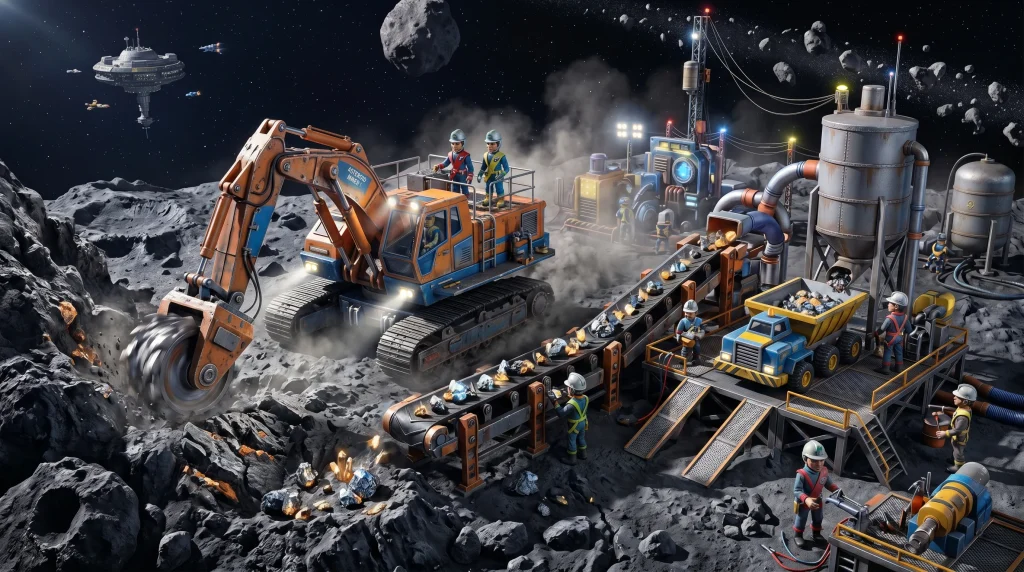
- Surface mining: Robotic vehicles land on the asteroid's surface and collect material. It is similar in principle to how Mars rovers operate, but far more aggressive.
- Thermal extraction: Using solar energy to heat the asteroid and collect the metals and water that evaporate. Yes, you can think of it as a kind of "steam boiler" in space.
- Magnetic collection: For M-type metallic asteroids, using powerful magnets to attract iron-bearing particles.
The most practical first step will most likely be extracting water. Why? Because you can split water into hydrogen and oxygen through electrolysis. That means rocket fuel. Setting up a fuel station in space is astronomically cheaper than hauling cargo from Earth every single time.
Consider this: right now, the cost of launching a rocket from Earth runs into thousands of dollars per kilogram. With fuel produced from an asteroid, that equation changes completely. This is not just the economics of asteroid mining. It is the economics of all space exploration.
Who Is Doing It, and How Far Have We Come?
As of 2026, there are both institutional and private players making genuine progress in this field. Japan's JAXA agency holds a leading position in this race. With the Hayabusa2 mission, they collected samples from the Ryugu asteroid and brought them back to Earth. This was not just a scientific triumph. It was the very message that says, "Yes, it can be done."
NASA's OSIRIS-REx mission also returned samples from the asteroid Bennu. Now that same spacecraft is continuing its journey toward an asteroid called Apophis. Apophis is an object that will make a close approach to Earth in 2029, offering a unique opportunity for observation.
On the private sector front, things are far more active and speculative. Various ventures are developing plans and filing patents around asteroid mining. But let us be honest: no private company has yet extracted resources from asteroids at a commercial scale. We are still on this side of that threshold.
You can also find other articles on space exploration in our Astronomy category.
Every Gold Rush Has Its "But"
The California gold rush of 1848 created fortunes, but it also brought environmental destruction, the displacement of indigenous peoples, and collapse. It would be naive to think space offers such a clean stage.
The real risks currently being discussed are as follows:
- Risk of economic collapse: What happens if a massive quantity of platinum is suddenly dumped onto the platinum market? The value crashes. This could deeply affect economies tied to existing mining operations, particularly countries like South Africa.
- Legal uncertainty: Space law is not yet prepared for this scenario. Who would an asteroid be considered to "belong" to? The 1967 Outer Space Treaty states that space is the "common heritage of mankind," but it does not explicitly prohibit mining. It is a very open area for interpretation.
- Risk of technical failure: Something "not working" in space is far easier than you might think. And every failed mission means billions of dollars in losses.
- Ethical questions: Who will the resources belong to? A handful of countries and companies with the technology, or humanity as a whole?
The answers to these questions will determine how asteroid mining takes shape. Even if the technical questions are resolved, the political and ethical questions will remain on the table for much longer.
So What Does the Future Hold?
Asteroid mining will develop gradually but inevitably over the coming decades. In the first phase, scientific missions will continue collecting samples. Then will come small-scale experiments aimed at extracting fuel and water. Large-scale metallic extraction is perhaps the work of the 2040s, or perhaps the 2050s.
But keep this in mind: throughout human history, technological revolutions have always moved faster than expected from the stage of "seems impossible" to the stage of "why didn't we do this sooner?" Only 66 years passed between the Wright Brothers' airplane and modern commercial aviation. 66 years. A single human lifetime.
The scientists today watching a capsule of asteroid samples fall back to Earth are, in fact, writing the first page of this revolution. And on that page, there are sentences we have not yet been able to read.
The next time you look up at the night sky and notice an asteroid passing among the stars, you are not just seeing a rock. You are seeing a resource depot, a fuel station, and perhaps the raw material of humanity's future in space.
It does not count unless you tell someone about it.
