

Hold On a Second! Is Perpetual Motion Possible?
In physics class, we were always told: you can't build a perpetually moving machine. If no energy comes in, the system stops. The second law of thermodynamics is pretty strict about this. If you tried to argue otherwise, a physicist would curl their lip, shake their head, and say "no, not happening."
But what if I told you: in 2017, a group of physicists kind of did exactly that? Of course, they didn't build a perpetual motion machine. But they discovered something very close to it. And its name is nothing short of poetic: a time crystal.
When I first heard this concept, I thought "this must be a sci-fi thing." Then I started reading. And I realized: the time crystal is perhaps one of the strangest, most beautiful states of matter. Let's take a look together.
First, Let's Understand a Regular Crystal
Think of a crystal of table salt, for example. What is a salt crystal? It's sodium and chlorine atoms arranged in a regular, repeating pattern in space. Look to the right of one atom, and there's another at the same distance. Look to the left, same thing. Up, down, in every direction, a regular repetition.
Physicists call this "spatial symmetry breaking." (Let me open a parenthesis: this name sounds intimidating, but it's actually simple. The atoms don't arrange themselves randomly; they choose a specific order. It's like everyone on the dance floor simultaneously deciding to take the same step.)
Now ask yourself this: if there can be regular repetition in space... why not in time as well? That's the question Nobel Prize-winning physicist Frank Wilczek asked in 2012. And his answer was "why not?" For more on symmetry breaking and exotic states of matter, check out our science articles.
What Is a Time Crystal? Really.
A regular crystal repeats in space. A time crystal repeats in time. Let's be more concrete: say you have a group of atoms and you're nudging them at regular intervals, in a steady rhythm.
Normally, what happens? The atoms move in proportion to your energy input. Push fast, they spin fast; push slow, they move slow. The output matches the input. But in a time crystal, something strange happens: the atoms don't listen to you.
You're nudging them every two seconds, but they oscillate every four seconds. They have their own rhythm. Despite the energy coming from outside, they insist on their own cycle. And that cycle keeps going without dampening.
At this point, you should be asking: "hold on, doesn't this violate conservation of energy?" Great question. The answer is: no, it doesn't. Because the system stays in a quantum state free from dissipation no energy lost to friction or external leakage. This isn't a classical machine; it's a structure that lives in the strange, mysterious world of quantum mechanics.
2017: The "Impossible" Showed Up in the Lab
Wilczek's 2012 idea wasn't taken very seriously at first. Some physicists even thought they had mathematically proven that a time crystal couldn't be possible. (We now know how hilariously these kinds of "I proved it can't work" moments tend to backfire in the history of physics.)
Then in 2017, two separate teams, one from the University of Maryland and one from Harvard, independently announced that they had created time crystals. Two different methods, two different materials, the same result. The original findings were published in Nature, and the physics world went very quiet for a moment.
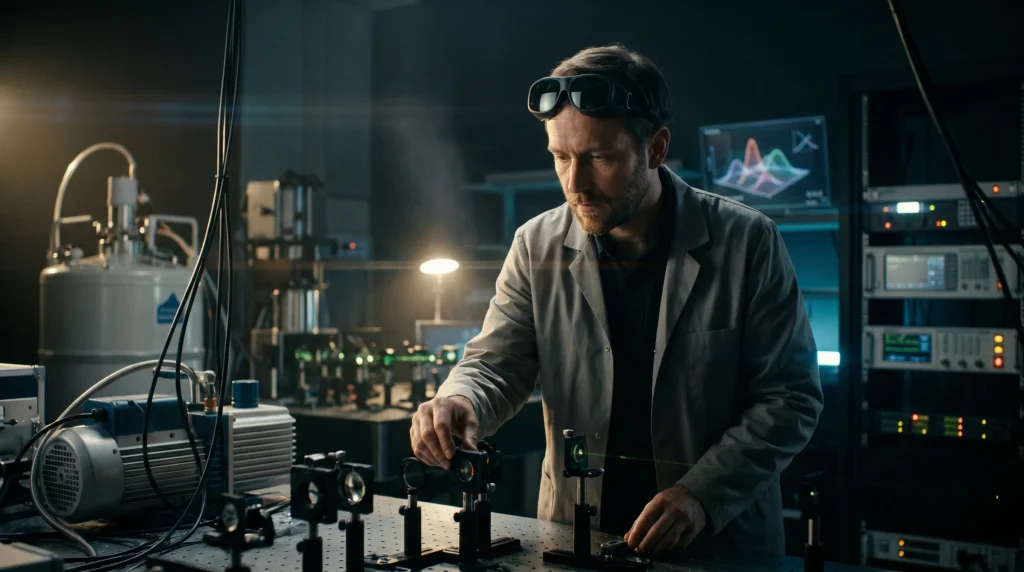
The Maryland team used ytterbium atoms. The Harvard team used nitrogen-vacancy centers in diamond (nitrogen-vacancy centers atomic defects inside diamond; sounds bad, but it's actually a remarkable tool). In both cases, the atoms moved in a rhythm different from the external rhythm applied to them. And the motion didn't fade. It continued.
So What Do We Gain From This?
This is where things get interesting. Time crystals aren't just a purely theoretical beauty; they have practical applications too. And some of these applications could be genuinely game-changing. If you're into the broader implications of quantum physics, don't miss our physics pieces as well.
- Error protection for quantum computers: The biggest enemy of quantum computers is "noise" vibrations, heat, and electromagnetic interference from the outside world. These disrupt quantum states. Time crystals, however, resist external perturbations. That makes them ideal candidates for stable information storage in quantum computers.
- Ultra-precise timekeeping mechanisms: If a system oscillates continuously and regularly on its own, that makes it a perfect clock. Even more precise than atomic clocks.
- Understanding new states of matter: Beyond solid, liquid, gas, and plasma, new entries are being added to the list. Time crystals are reshaping our understanding of the forms matter can take in the universe.
As of 2026, this field is still developing. Researchers are trying to produce time crystals at room temperature. For now, most experiments are conducted at very low temperatures where quantum systems behave properly. If that barrier is overcome, things will change in a serious way.
A Thought Experiment: The Rebellion of Rhythm
Imagine this: there's a disco, and the DJ is playing music at a certain tempo. Everyone dances to that tempo, you, me, everyone. This is like a regular crystal: the energy coming from outside determines the movement inside.
Now imagine that some of the people on the dance floor suddenly start dancing to their own rhythm. No matter what the DJ does, they keep going at their own tempo. And they don't get tired. They don't lose energy. They just... keep going. That's a time crystal.
A system that insists on its own rhythm in defiance of the rhythm imposed from outside and this insistence happens without "violating" thermodynamics, thanks to the strange rules of quantum mechanics. (I know this analogy isn't perfectly accurate, but it works for capturing the intuition. Feynman would've done the same thing.)
Matter Still Surprises Us
Physics students are often given the impression that "the big things have already been discovered, we're just filling in the details now." This idea is both wrong and dangerous, because it kills curiosity.
The time crystal reminds us: matter still has surprises up its sleeve. We've been working with atomic physics for centuries, yet there are still corners where we can say "wait, we never thought of this." For more mind-bending ideas about the nature of reality, explore our science category.
And you don't need a billion-dollar laboratory to discover those corners. Sometimes all it takes is asking the right question: "If repetition can happen in space, why not in time?" Wilczek asked that. And physics was never quite the same again.
One Last Thing
Next time you look at an ice cube in your glass, notice that neat, angular structure of atoms repeating in space. Let a thought linger in the back of your mind: Could that ice cube have formed a time crystal through time as well?
For now, the answer is "no, but..." And that "but" is still being written. And the things we don't know are far more exciting than the things we do.