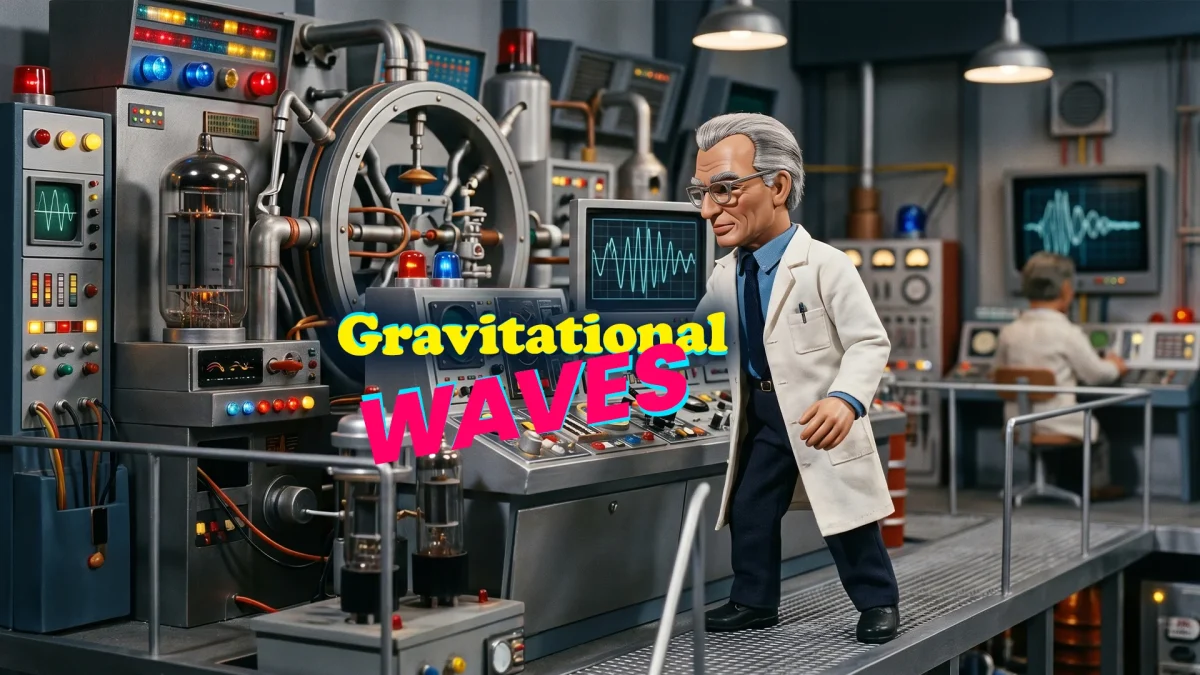

Gravitational Waves: Is Space Really Vibrating?
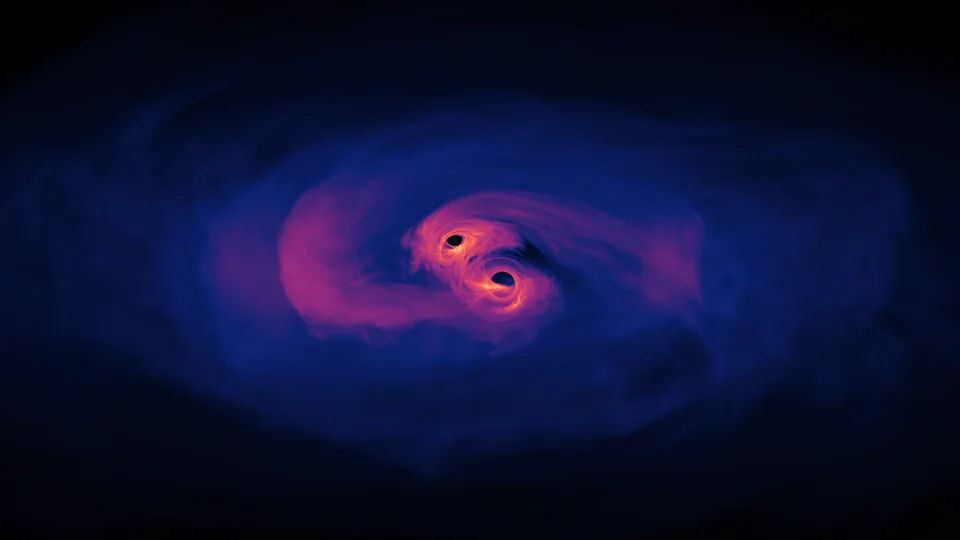
Think about this for a moment. You are drinking your morning coffee, everything is ordinary, the world is turning. And at that very moment, two black holes collide billions of light years away.
The energy released in an instant is many times greater than all the energy our sun will ever radiate throughout its entire lifetime. And this collision causes spacetime, that fabric in which everything that exists is floating, to tremble like jelly.
That vibration travels straight toward you. It passes right through you. Even now, as you read these words.
That is what gravitational waves are. And we can now hear them.
So What Exactly Is a Gravitational Wave?
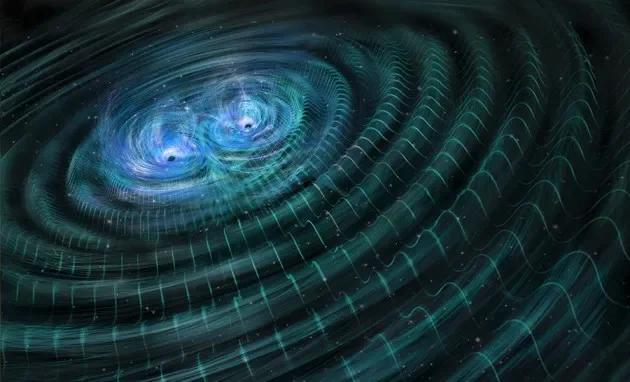
Let us take a step back. When Einstein published his General Theory of Relativity in 1915, he was saying this: gravity is not a force, it is the curvature of spacetime. Just as a ball creates a dip in a blanket, massive objects bend space and other objects simply follow that curvature.
All right, you may have heard that part before. But now comes the interesting bit. Einstein also derived the following from the same theory: if you shake that blanket very quickly, the dip spreads outward around you. Waves form. Waves inside spacetime. We call these gravitational waves.
To put it simply: if light waves are vibrations of electric and magnetic fields, then gravitational waves are vibrations of spacetime itself. Physics tells us that as a wave passes, the length of your arm stretches and contracts by an amount smaller than the nucleus of an atom. (This part genuinely stunned me the first time I heard it.)
Why as Small as an Atom?
Gravity is the weakest of the four fundamental forces. It is 10 to the power of 36 times weaker than electromagnetism. So even a black hole collision, by the time it reaches Earth, produces a stretching of only about one thousandth of a proton's diameter.
Detecting this signal is like trying to hear someone shouting at an ant from Istanbul.
That is why finding these waves seemed impossible for decades. Until LIGO came along.
How Does LIGO Hear This?
LIGO (Laser Interferometer Gravitational-Wave Observatory) is a giant laser system built at two separate locations in the United States, in Louisiana and Washington. Each site has two arms, each arm is 4 kilometers long, and they are positioned at right angles to each other.
The operating principle is as follows. You measure the distance between mirrors placed at the ends of the two arms using laser light with extreme precision. When a gravitational wave passes, spacetime vibrates, causing one arm to stretch slightly while the other shortens slightly. The difference is less than one thousandth of a proton's diameter. But LIGO captures it.
Wait a minute. Your mind is probably asking, "Does the laser light not stretch and contract in the same way?" Great question. The answer is: yes, light is also affected, but we can measure the phase difference the wave creates in each arm. The details are complex, but that is the essence of it.
Why Are There Two Detectors?
Because with a single detector you cannot separate the signal from the noise. A passing truck in Louisiana could also affect the detector. But if the same signal appears simultaneously in Washington, 3,000 kilometers away, that is no longer local noise. That means something universal is happening.
What Have We Found So Far?
The first discovery came in 2015. The official announcement was made in 2016. That signal came from the merger of two black holes approximately 1.3 billion light years away. Two black holes with masses 29 and 36 times that of our sun had been spiraling toward each other and eventually merged into a single black hole. The energy released during that merger was equivalent to roughly 3 solar masses, and all of it had radiated as gravitational waves in less than a second.
On that day, more than 1,000 scientists around the world realized this simultaneously. And some of them cried. Can you believe that? Decades of work, finally bearing fruit.
Since then, many more signals have been captured. Not only black hole mergers, but neutron star collisions as well. The GW170817 signal detected in 2017 was especially significant: both gravitational waves and electromagnetic radiation were observed at the same time. This marked the beginning of a new era in astronomy called multi-messenger astronomy.
As of 2026, LIGO and its European counterpart Virgo continue to capture an increasing number of signals with their updated sensitivity. With each new observation run, the number of signals doubles compared to the previous one.
Why Is This Such a Big Deal?
Think of it this way. For thousands of years, humanity studied the universe only with its eyes, that is, with light. After the invention of the telescope, we used visible light, then radio waves, X-rays, and gamma rays, covering every band of the spectrum.
But what do all of these have in common? They were all electromagnetic waves. Meaning we were always speaking the same language with the universe.
Gravitational waves are an entirely different language. Independent of electromagnetism. They travel to places where light cannot reach. With this new language, we will be able to understand what happens inside black holes, what the earliest moments of the universe looked like, and perhaps even matter types we do not yet know.
This is like suddenly having our hearing restored. For billions of years we understood the world only by seeing it. Now we have begun to hear it as well.
A Census of Black Holes
Thanks to gravitational waves, we have learned this: black holes are far more diverse than we imagined from astronomy textbooks. They appear in unexpected masses and unexpected combinations. This calls into question our theories about how black holes form. You can also check out other articles on this topic in our Physics category.
What Comes Next?
Imagine building a gravitational wave detector in space. Laser arms placed millions of kilometers apart, completely free from the vibration noise of Earth. That is exactly what the LISA (Laser Interferometer Space Antenna) project aims to achieve. The arm length will be 2.5 million kilometers. This will allow us to hear gravitational waves across entirely different frequency ranges.
And after that? Perhaps we can capture gravitational waves that formed just a few seconds after the Big Bang. No electromagnetic signal from that moment can reach us, because the universe was not transparent to light at that time. But gravitational waves can pass through.
So theoretically, we could hear the sound of the birth of the universe.
(My eyes got a little watery writing that sentence, I will admit.)
The truly fascinating part of gravitational wave physics still lies ahead of us. What we know is barely a drop compared to what we do not know. And that is precisely why, the next time you see your shadow on the ground, think about this: space bent and curved to create that shadow. And sometimes that bending ripples outward. For billions of years, silently.
Now the real question is this: How much sound have we already missed?