
They taught us there are four states of matter. Solid, liquid, gas, plasma. Plasma physics is the field that studies the most exotic, most wild, and actually most common of these four states in the universe. And let me tell you, once you dive into this topic, saying "oh yes I know, the sun is plasma" will no longer be enough for you.
Let's dive right into it.
What Is Plasma, and Why Is It Strange?
Think of a gas. Atoms are flying around, independent of each other, free. Now keep heating that gas, much more. At a certain point, the atoms gain so much energy that electrons break free from the nucleus. Now we have a soup of freely moving charged particles on our hands. That is plasma.
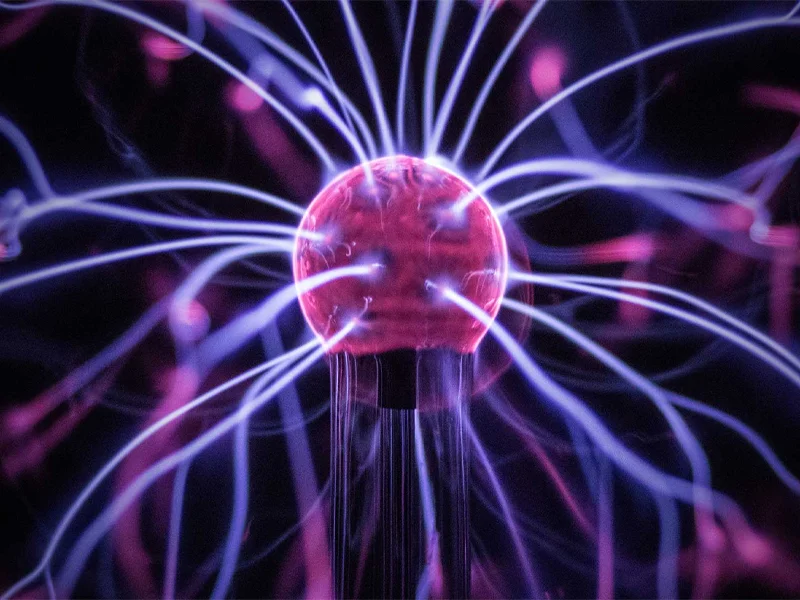
But here's where things get interesting. Because plasma behaves completely differently from any ordinary gas. It responds to electric and magnetic fields, moves according to its own internal dynamics, and forms complex waves and structures. A gas will say "hello" to you. Plasma will ask you for a dance.
Not Four States, but Four Plus One
In school textbooks, plasma usually appears as a footnote. "It exists, you know, the sun and all that..." But you should know that more than 90% of the visible matter in the observable universe is in plasma form. Stars, interstellar gas clouds, the solar wind... All of these are plasma.
Because we live on Earth surrounded by solids, liquids, and gases, plasma seems exotic to us. In reality, the exotic ones are the three states we are familiar with. The universe is the playground of plasma physics. We are just standing quietly in a small corner of it.
The Sun Is Already a Massive Ball of Plasma
What comes to mind when you think of the Sun? Hot, yellow, bright. Yes. But the way the mechanism works is that hydrogen atoms in the core of the Sun repel each other, but gravity is so enormous that it overcomes this repulsion and the nuclei fuse together. We call this nuclear fusion. And this reaction keeps the Sun burning as a ball of plasma for billions of years.
Those sunspots on the surface of the Sun, coronal mass ejections, the solar wind... Behind all of these lies the strange and complex magnetohydrodynamic behavior of plasma. You can check out NASA's solar research to read more and to understand these dynamics.
Putting a Star in a Bottle
This is the real heart of the matter. Humanity has been asking the same question for decades - can we replicate the reaction happening inside the Sun, right here, in a reactor?
Theoretically, the answer is "yes." Practically, it is "very hard, but we are getting closer." And plasma physics is right at the center of this process of getting closer.
The most widely used design in fusion reactors is the tokamak. Developed by Russian scientists in the 1950s, this ring-shaped reactor keeps plasma under control using enormously powerful magnetic fields. Because no physical material can withstand fusion temperatures (hundreds of millions of degrees). So the plasma is confined in a magnetic cage. We call this magnetic confinement.
Let us put this temperature into perspective... You are creating a plasma ten times hotter than the core of the Sun, and you are trying to hold it in place with a magnetic field. This is quite literally "putting a star in a bottle."
What is ITER and where is it right now?
ITER is a massive international fusion reactor project being built in the south of France. It is a joint project of 35 countries, including the European Union, the United States, Russia, China, Japan, India, and South Korea. The goal is to prove whether fusion can actually work for generating energy.
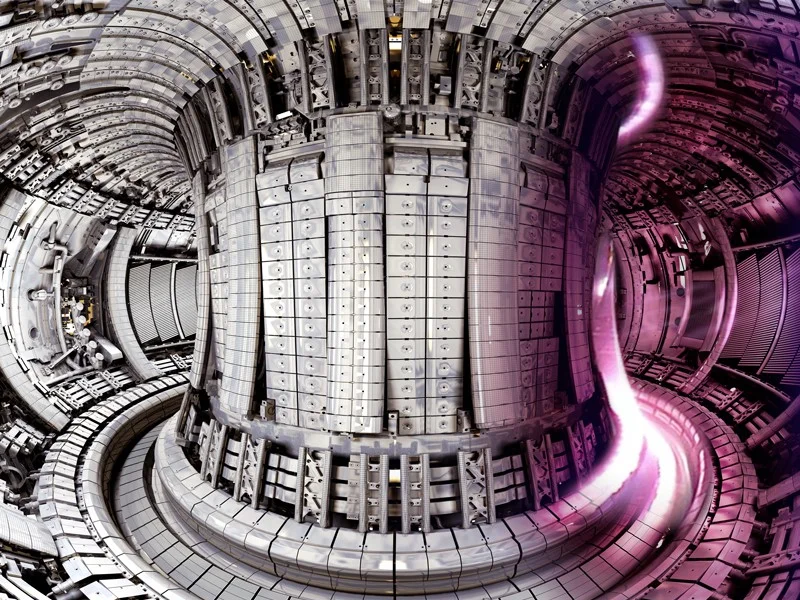
As of 2026, ITER continues to make progress through its assembly phase. The project timeline has gone through revisions, and there have been cost and logistics challenges. We know all of this. But this does not diminish the importance of the project. You can follow the latest developments on ITER's official website.
In parallel, the private sector has also entered this field seriously. Many startups are working with tokamak and alternative confinement methods. This competitive environment has taken the field to a much more exciting place.
Why Does This Matter So Much?
Think of it. If a fusion reactor is successfully operated, you can use deuterium found in the water of the oceans as fuel. An almost limitless, practically inexhaustible energy source. No carbon emissions, no long-lived radioactive waste, no meltdown risk.
This is more than a physics experiment. This is one of the clearest answers humanity could give to its energy problem. And at the foundation of all of this lies understanding how plasma behaves.
That is why plasma physics is not purely an academic subject. Every tokamak experiment, every magnetic confinement simulation, matters and counts directly into the future of energy.
If this caught your interest, you can also check out other posts in the 2HBN Physics category. We have covered topics like gravitational waves, and those kinds of "Wait, what?" moments about the universe are waiting for you there.
Is this peak? It's peak.
Plasma physics is, in my view, one of the most "peak" topics within physics. It is necessary for understanding the universe, and at the same time it is critical for solving a concrete problem right here on Earth. Theoretical beauty and practical need exist at the same time.
And despite every "fusion energy is 30 years away" joke, we are genuinely getting closer now. Maybe this time we should take it seriously.
Maybe we can utilize the plasma energy and meet on Neptune later.