
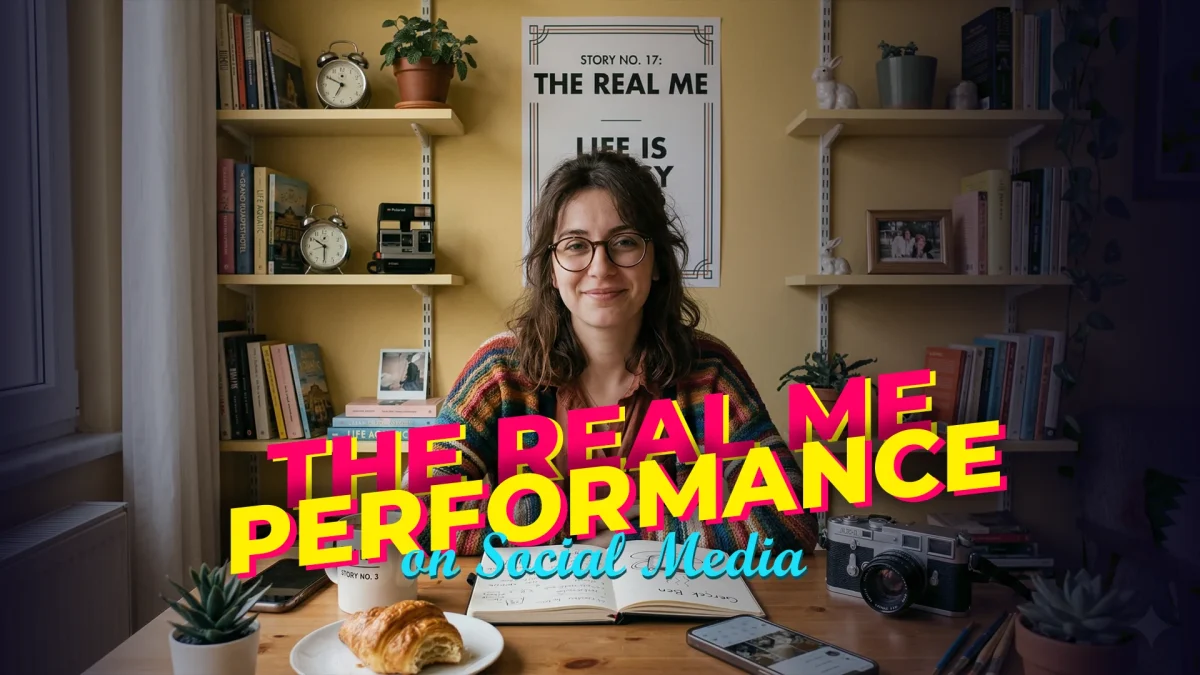

The Performance We All Pretend We're Not Doing
Let's be honest: we don't really believe someone when they say "I'm completely myself on social media." Maybe we want to believe it, but deep down, there's a small voice in the corner asking: "How many takes did it actually take to get that photo?"
We're all doing the same thing. Social media authenticity, or at least the appearance of it, has become its own carefully constructed aesthetic. And perhaps the most interesting part of this strange cycle is that even "looking authentic" has become a performance unto itself.
Everyone Is Selling a Version of Themselves
Take a look at people's social media accounts for a moment. Everyone has a persona. And I don't mean that in a cynical way. It's actually a very human thing. In everyday life, "me with my coworkers", "me with my family", and "me with my best friend" are all different versions of the same person.
Social psychologists call this impression management. And it's not a new concept. Erving Goffman wrote an entire book about it back in 1959. The Presentation of Self in Everyday Life and it holds up disturbingly well in the age of Instagram. What's new is that we're now doing that impression management constantly, for everyone, all at the same time. And we're getting instant feedback in the form of like counts. That combination seems to... mess with people a little.
For more on how our online personas shape real-world psychology, check out our culture and society articles.
The "No Filter" Filter
At some point, everyone got tired of the over-filtered, hyper-perfect content on Instagram. In response, a new trend emerged: raw content. Right-out-of-bed selfies, messy rooms, bare faces, the whole "you're seeing the real me" vibe.
A genuine reaction. Truly.
But have you noticed? Those "no makeup" selfies are still taken in just the right light. The "messy room" photos somehow make even the clutter look aesthetic. That seemingly spontaneous moment was actually retaken five times. And underneath the "no filter" caption, there's still a ton of color grading going on.
So a thing called the "authenticity performance" was born. And it might be even more insidious than what came before it, because it's much harder to recognize. Social media authenticity, it turns out, is one of the slipperiest concepts on the internet.
What Did the BeReal Experiment Teach Us?
Do you remember BeReal? Once a day, at a random moment, you'd get a notification. Both the front and back cameras would capture the shot simultaneously, you had two minutes. No edits, no preparation, just share the "real moment."
It was a brilliantly clever idea. And for a while, it was genuinely fun.
Then what happened? When people got the notification, they started saying "just a sec." They'd move to a better spot, try to capture themselves doing something "more interesting," or they'd ignore the notification and wait, thinking "it'll look better if I take this in the afternoon." The app technically showed when a post was late, but people eventually made peace with that too.
So an app designed to enforce spontaneity ended up killing spontaneity. The human mind is truly a remarkable thing. You can read more about BeReal's rise and the authenticity trap over at The Verge.
So Does This Make Us Unhappy?
That's the real question. The question of "does social media make us unhappy?" has become almost cliché at this point — someone brings it up in every TED talk. But the answer is more nuanced than I used to think.
Research paints a complicated picture, no surprise there. Passive consumption, meaning just scrolling and watching without liking or commenting, genuinely does make people feel worse. Active engagement, real, meaningful interaction with friends, isn't nearly as harmful. But that line keeps blurring, because feed design pushes you toward passive consumption rather than active participation.
Then there's the comparison problem. No matter how many times we're told not to do it, the brain does it automatically. As an evolutionary reflex, we're constantly calculating "where do I stand in the social hierarchy?" And social media forces us to run that calculation 24/7 while comparing ourselves to everyone else's highlight reels.
But It's Not All Bad Either
Hold on, let's be fair for a moment.
Thanks to social media, it's become so much easier to find people who are genuinely like you. Someone growing up in a small town, passionately devoted to something nobody around them cares about, can now find their own community online. That's genuinely valuable.
Or someone struggling with a particular mental health issue no longer has to feel alone when they find content from people who've been through the same experience. That's valuable too.
The problem isn't the tool, it's the design. And more specifically, it's the attention economy. The longer platforms hold your attention, the more money they make. That means they need to serve you content that pulls you into a dopamine loop. Outrage, anxiety, jealousy... these things keep you glued to the screen. Calm and contentment? Not so much.
Digital Identity Anxiety: Is This Something New?
There's a lot of talk about Gen Z experiencing digital identity anxiety and social media authenticity struggles. And it's real. But it's also worth saying this: every generation has had its own identity pressures. My generation (we can say Millennial, yes, I'm owning it) compared itself through school hallways, friend groups, and the aesthetics of MTV. And the generations before us had their own pressures too, of course.

The difference now is 24 hours a day, in your pocket, with notifications. And there's this too: social pressure in physical spaces at least had an endpoint. You could go home and leave it behind. Digital social pressure has no physical endpoint. You get into bed, you check your phone, and it's still right there.
Want to dig deeper into how digital culture shapes who we think we are? Browse our technology and digital culture pieces for more.
So What Should We Do? (No, I'm Not Going to Say "Put Down Your Phone")
The advice to "delete social media" is neither practical nor does it get to the heart of the matter. Work life, social connections, staying informed... all of it has migrated onto digital infrastructure in one way or another. "Just opt out" is a luxury at this point. But here's what you can do:
- Notice passive consumption. If you're just scrolling and you catch yourself doing it, stop. The brain responds well to that kind of conscious interrupt.
- Pay attention to who you follow. Accounts that consistently make you feel inadequate, even if it's a real friend — there's no shame in hitting mute.
- Turn off notifications after you post. That loop of obsessively checking your like count in the first half hour genuinely isn't healthy.
- For yourself, or for others? Ask yourself this before you share something. Even if you don't know the answer, the act of asking is enough.
And one last thing: Realizing you're performing doesn't make you fake. We're all doing it. What matters is staying honest with yourself behind the performance, or at the very least, putting your phone down every now and then and staring out the window. Old-fashioned, but it works.
What's the strangest performative content you've ever come across on social media? I'm genuinely curious, let me know in the comments.


