
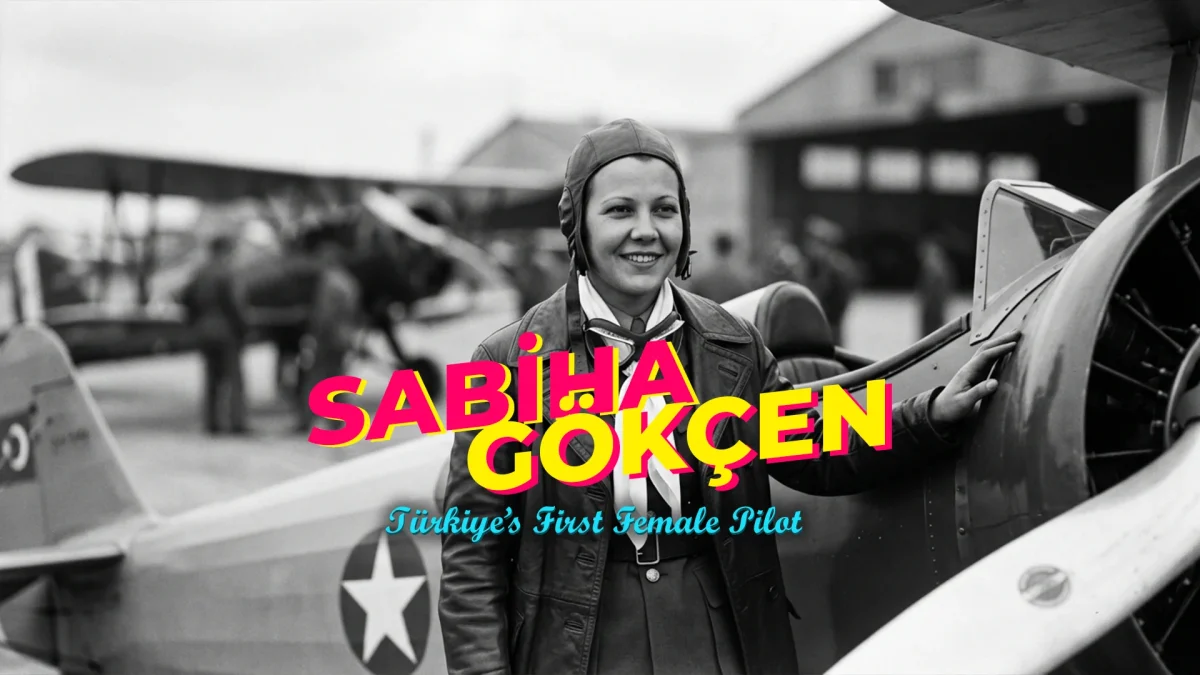

Who Is Turkey's First Female Pilot?
If there is anyone among you wondering about the answer to this question, you are in the right place. In this post, we commemorate Sabiha Gökçen, the first female pilot our country has ever produced. Sabiha Gökçen is an exceptional woman who has inscribed her name not only in Turkey's aviation history but in the entire world's aviation history.
This brave woman, who took to the skies during one of the most challenging periods of the young Turkish Republic, continues to inspire millions to this day. Sabiha Gökçen was not merely a pilot. She also became a symbol who proved to the entire world what Turkish women are capable of achieving.

Who Is Sabiha Gökçen?
In her most well-known and straightforward definition, Gökçen is "the world's first female combat pilot" and our country's "first female pilot." This title is the clearest proof of how extraordinary a life she led.
At a time when women's very presence in the public sphere was a matter of debate in many countries, Sabiha Gökçen made history as a pilot who personally flew combat aircraft. This achievement, which marked a true turning point not only for Turkey but for the entire world's aviation history, is still referenced with great respect in numerous sources today.
If you are curious to learn more about the history of women's rights and aviation, you can also browse our history articles.
Where Does the Surname Gökçen Come From?
Gökçen was born in Bursa in March 22, 1913. Following the death of her parents, she was adopted by Mustafa Kemal Atatürk during his visit to Bursa in 1925. The surname "Gökçen" was given to her by Atatürk following the adoption of the Surname Law in 1934.

The word "Gökçen," meaning "belonging to the sky, celestial" in Turkish, seems like a reflection of the dreams Atatürk held for Sabiha and the confidence he placed in her. Indeed, in the years that followed, this name soared through the skies in a manner perfectly befitting its meaning.
The bond Sabiha formed with the Atatürk family made her not only a spiritual daughter but also a symbol of the new Turkish woman raised by the Republic. You can find more content about Republican-era female figures in our culture articles.
About Sabiha Gökçen
Having completed her primary education at Çankaya Primary School, Gökçen continued her education at Üsküdar American College for Girls. In 1935, she enrolled at the Turkish Aeronautical Association's Türk Kuşu Civil Aviation School.
Her advanced gliding certificates were obtained in Ankara. She completed her advanced gliding training in Crimea, Russia, alongside seven other students. Being the only woman among those seven students during the training process reveals just how determined and strong a character she possessed.
She had planned to attend a motorized aircraft school in Moscow. However, upon receiving news of the death of her adoptive sister Zehra, she gave up that plan and returned to Turkey. This training process was also the first sign that Gökçen would go on to serve as a combat pilot in the years ahead.
Participating in the Dersim military operation in 1937 and taking on a combat role, Gökçen officially earned the title of "the world's first female combat pilot." This historic flight has secured an important place not only in Turkish history but in the entire world's aviation literature. You can also find comprehensive information on the Sabiha Gökçen page on Wikipedia.
In 1938, she made a tour of the Balkans by aircraft as a guest of the Balkan states. Upon her return to Turkey, she was appointed "Chief Instructor" at the Turkish Aeronautical Association's Türkkuşu. Gökçen held this position until 1955.

The Balkan tour was an exceptionally bold and symbolic undertaking for its time. This flight, carried out as a guest of neighboring countries, raised Turkey's international profile and showcased the young Republic's modern, forward-thinking face to the regional public. On this tour, Gökçen served simultaneously as an ambassador, a pilot, and a representative of Turkish women.
Visiting the United States in 1953 and 1959 by invitation, Gökçen introduced Turkish society and Turkish women to American audiences.
Her visits to the United States further demonstrate that Gökçen was far more than just a pilot. She was also an ambassador who conveyed her country's cultural and social achievements to the world. The promotional work she carried out on behalf of Turkey during the complex international climate of the Cold War era made a positive contribution to our country's image in the Western world.
Sabiha Gökçen's Firsts and Awards
In 1996, she received the greatest award of her aviation career. At a ceremony held at Maxwell Air Force Base, where she attended as the guest of honor at the Eagles Gathering organized for the graduation ceremony of the American Air War College, she was selected as one of the "20 Aviators Who Left Their Mark on World History." Sabiha Gökçen became the first and only female aviator to receive this honor.
This list of twenty individuals includes names who have become defining figures in world aviation history, such as the Wright Brothers. The fact that Gökçen is the only woman on this list speaks unequivocally to her standing at the international level. It is also a testament to Turkish aviation's rightful place on the global stage.
The highlights of Gökçen's career, filled with firsts and awards, can be expressed in the following numbers: she flew approximately 22 different types of aircraft and completed more than 8,000 hours of flight. She achieved the vast majority of these accomplishments during an era when inequalities for women were extremely pronounced.
For more information about important female figures in world aviation history, you can also visit the Museum of Women Pilots website.
Sabiha Gökçen's Final Flight
She made her final flight in 1996 at the age of 83, accompanied by French pilot Daniel Acton, aboard a Falcon 2000 aircraft. This flight, undertaken at the age of 83, is a touching moment that shows Gökçen had not lost her passion for aviation even in the final years of her life.
Young Sabiha, who had once risen into the skies on gliders decades before, this time took her seat in a modern jet aircraft and brought her career to a close. This final flight also stands as a lasting testament to both her physical and spiritual resilience.
Sabiha Gökçen passed away in Ankara on March 22, 2001. The legacy she left behind, however, continues to live on for many years to come.
Sabiha Gökçen International Airport
Gökçen's name was given to Istanbul's second airport, which opened in 2001. Located within the boundaries of the Pendik district on the Anatolian side of Istanbul, Sabiha Gökçen Airport has an annual capacity of 3 million international passengers, 500,000 domestic passengers, and 90,000 tons of cargo.

The decision to give this name to the second international airport of Istanbul, one of the world's most densely populated cities, is the most tangible expression of the respect and gratitude felt toward Gökçen. Having become a destination for millions of passengers every year, this airport continues to grow and develop in a manner that does justice to the spirit of the woman whose name it bears.
Sabiha Gökçen's name now lives not only on the pages of history but also in the skies above Istanbul. If you are curious to learn more about the history of Turkish aviation, you can also take a look at our history content.
Source Used: Sabiha Gökçen Airport Official Website